An Ecosystem for Backlog Management
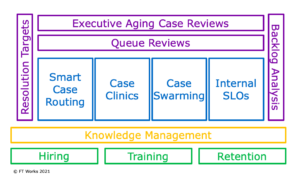
If you think that backlog management is only about (1) measuring the backlog and (2) encouraging the team to work faster, you are likely finding that it’s not quite enough. Instead, I encourage you to place backlog management in a proper ecosystem, one you can build and nurture to manage the backlog, if not effortlessly (backlog management is hard work!), at least reasonably smoothly, and successfully.
Looking at the illustration, backlog management starts with proper people management (green boxes). You need to hire the right team members, with the right skills (both technical and customer skills) and the desire to help customers. You need to train them properly, and you need to retain them.
Second, you need a solid knowledge management program (yellow box). If you reinvent the wheel every time, your efficiency will be low and the backlog will grow.
Third, you need a properly structured case management process (blue boxes) with four components: case routing, case clinics, case swarming, and internal SLOs.
- Case routing (or assignment) gets each case to the right person fast, ideally without having a dedicated queue manager. The right owner will be able to resolve issues without delays.
- Case clinics (or scrums, or reviews) bring your support engineers together with senior engineers to compare notes and get immediate help on the cases that stump them.
- Case swarming or collaboration allow the support engineers to get in-depth assistance when needed, above and beyond what can be discussed in a clinic. You need a frictionless tool, no shaming for the requesters, and proper recognition for the helpers.
- Internal SLOs with Engineering, DevOps, or other teams you depend on minimize delays when you need outside assistance. From a customer’s perspective, a case waiting for engineering is still an open case.
And we finally get to what is classically considered backlog management processes (purple boxes).
- Resolution targets help everyone focus on a speedy resolution. For complex support, a reasonable target may be a week, shooting for perhaps 80% of cases resolved in a week. Any case older than that is “aging” and subject to scrutiny.
- Managers must conduct queue reviews on a regular schedule, with all support engineers. The goal is to spot “stuck” cases and help move them to resolution.
- Backlog analysis uncovers trends in the backlog. For instance, do we need more training on a particular topic? Is the engineering backlog ballooning? Do we need to train the support engineers on how to handle customers who disengage?
- Finally, regular executive aging case reviews give visibility to aging cases. If your backlog is very high, start by reviewing truly ancient cases (say, more than 3 months old) and gradually ratchet down to merely aging case as the list shrinks.
How are you doing with your backlog ecosystem? Tell us in the comments.